← Back to JavaScript
10

Functions in JavaScript: encapsulate logic with intention

Learn the foundations of functions so you can avoid duplication, improve readability and build reusable pieces with parameters, return values and modern syntax.

📘 Theory

Why functions change the way you program

Programming well is not about writing more code. It is about organizing logic better.

Every time you spot a repeated pattern, a function is a natural candidate to encapsulate it and remove duplication.

Functions also force you to define a clear contract: what they receive, what they do and what they return. That reduces ambiguity.

1

Reuse

2

Readability

3

Maintenance

4
Debugging

Declaring functions with `function`

The minimum structure is simple: name, parameters, body and optional return value.

A classic function declaration reads very well in business logic blocks or anywhere you want explicit clarity.

Prefer verbal and expressive names so the function documents its own purpose.

  • Parameters are expected inputs.
  • Arguments are the real values you pass when calling the function.
  • A clear name is better than a short but vague one.
  • Keep one main responsibility per function.

Default parameters and resilience

Design functions that do not break when optional data is missing.

1

Default parameters prevent unexpected `undefined` values in simple messages and calculations.

2

This is useful for internal APIs where some options can be omitted without breaking the main flow.

`return` and flow control

When a function hits `return`, its execution ends immediately.

1

`return` defines the output and also acts like a stop instruction. That makes early validation strategies possible without unnecessary nested conditions.

2

Forgetting `return` is one of the most common beginner mistakes. If you do not return anything, the result will be `undefined`.

Arrow functions with good judgment

They give you more concise syntax in callbacks and small helpers without forcing them into every case.

Arrow functions are common in `map`, `filter`, event listeners and short utilities. They are convenient, but they are not automatically the best choice everywhere.

If a function grows or needs a lot of internal logic, a traditional declaration may still be more readable for a team.

  • Use arrow functions for short and expressive helpers.
  • Do not compress complex logic into one dense line.
  • Keep your style consistent inside the file or project.
  • Choose clarity over syntax fashion.

🧭 Key visuals

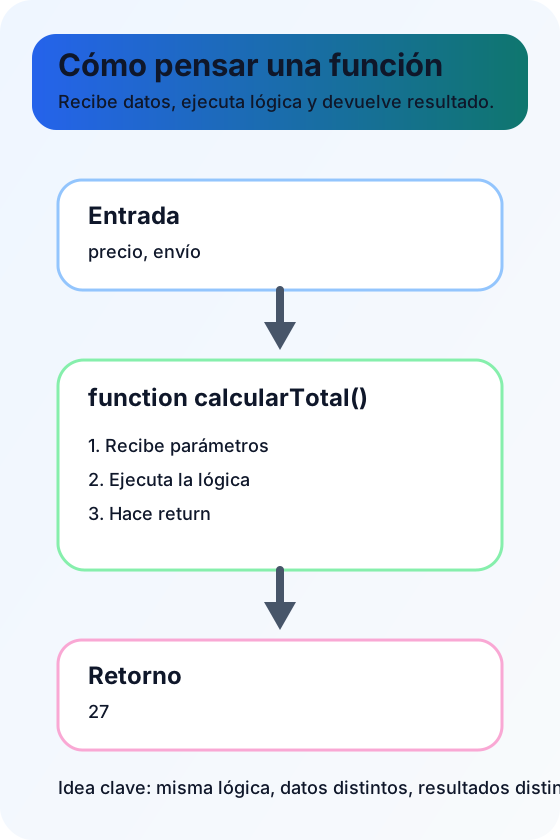
Input, logic block and return value of a function

It fits this beginner stage well because it helps students think of a function as a unit that receives, processes and returns.

Diagram of a reusable function with data input, internal logic and a returned result

🧪 Learn by doing

Example Guided example: a reusable function Call the same function with different data to see real reuse.
Example Guided example: default parameters Check the behavior with and without an optional argument.
Example Interactive demo: final price calculator Use a function to calculate the total with a selected discount from a small UI.
Example Interactive demo: final price with small functions Chain small functions to apply a discount, add tax and format the result without mixing everything into one block.

🏁 Challenges

Challenge Challenge 1: greeting function with a return value Declare a function that receives a name and returns a personalized greeting.
Challenge Challenge 2: a discount arrow function Implement an arrow function that calculates a final price based on a percentage.

What is this?

I'm Cristian Eslava and I sometimes build websites so both you and I can learn and experiment. culTest

I made this in February 2026 to make learning easier for my students. The idea is to learn web development by practicing and to keep expanding the project with new topics, tests and challenges.

It draws inspiration from MDN, W3Schools, CodePen, Manz and many other web development references. I wanted to combine useful theory, runnable examples, challenges and the testing system I had already built for culTest. culTest

If you liked it, if you didn't, or if you want to get in touch, write to me at cristianeslava@gmail.com